



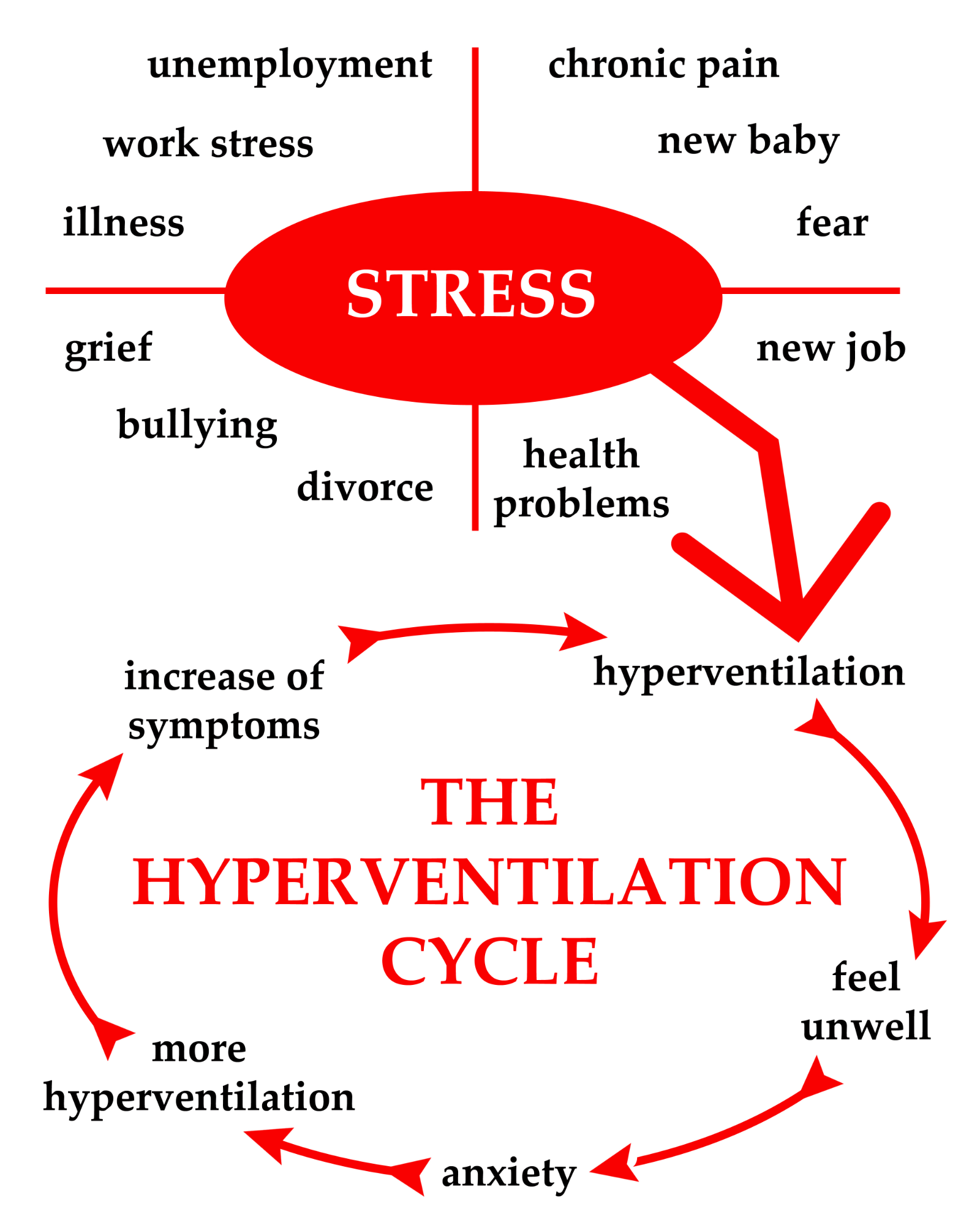
Out of nowhere, your heart rate starts to speed up. You feel weak and lightheaded and you feel like you can't take a deep enough breath. Suddenly your chest starts to hurt and your mind is racing. You feel like everything around you is crashing down – you feel like this might be it. All of the sudden you have one final moment of extreme terror…
… then gradually it starts to melt away.
You may know that what you experienced was a panic attack, and anxiety attacks often lead to intense physical symptoms. What you may not realize is that those physical symptoms were caused largely by hyperventilation, which is one of the responses that your body has during a panic attack.
Introduction to Hyperventilation
While anxiety is to blame for hyperventilation, hyperventilation is to blame for many of the other distressing symptoms associated with anxiety. Hyperventilation can cause so many problems that some doctors label it its own disorder, known as "hyperventilation syndrome."
It's most common in those with panic and anxiety attacks but may affect anyone that suffers from anxiety.
Hyperventilation literally translates to "over-breathing." Contrary to popular belief – and contrary to the way it makes you feel – it is not the act of getting too little air. Instead, hyperventilation is the act of exhaling carbon dioxide too quickly, causing too much oxygen to enter the lungs and an imbalance of the two within the bloodstream. Hyperventilation can occur in many different ways:
- Breathing Too Fast – Breathing too fast is the most common way to hyperventilate, and this is very common in the case of anxiety. During periods of intense anxiety, the body is sent into a state of fight or flight, when the brain signals to the body that danger is afoot. When this happens, you automatically start breathing quickly, as this oxygenates your blood and prepares your body to respond to a threat by fighting or fleeing. If the threat that has triggered your fight or flight response (whether real or imagined) persists, you’re likely to continue hyperventilating until you start to experience other unpleasant physical symptoms.
- Thinking About Breathing – Many people with panic attacks tend to actively think about their own breathing. Unfortunately, this can also lead to hyperventilation, because it causes your body to essentially breathe more than it needed to previously. By consciously monitoring your breathing which otherwise would occur naturally and spontaneously, you may unintentionally alter the rhythm of your breath, which could lead to hyperventilation.
- Unnecessary Deep Breaths – Finally, another way to hyperventilate is to take several unnecessarily deep and rapid breaths. If you tend to yawn when you're nervous or try to breathe in until your chest expands when your body isn't asking for it, that can lead to hyperventilation as well – especially if you're also inhaling too rapidly.
One of the main issues with hyperventilation is that you start to feel as if you’re struggling with shortness of breath. In other words, your body feels as though it's not getting enough oxygen, when the problem is actually quite the opposite.
So the reaction that most people have to hyperventilation is to unintentionally hyperventilate even more. They try to breathe in too much air too quickly because they feel like they're not getting enough air, but this just causes the situation to get worse.
Hyperventilation and Hyperventilation Syndrome
Hyperventilation is caused by anxiety, but hyperventilation can also end up warranting its own diagnosis: "hyperventilation syndrome." Hyperventilation syndrome is when you tend to hyperventilate even without anxiety present because your body has learned to breathe incorrectly, often as a result of excess stress or anxiety.
Although it is possible to have one without the other, the two often have links:
- Approximately 50% of patients with panic disorder manifest hyperventilation as a symptom
- 25% of patients with hyperventilation syndrome will eventually manifest panic disorder.
That's why hyperventilation is such an important thing to understand for those with anxiety. It's not only the cause of many of the worst anxiety symptoms – it also may become its own disorder that requires your attention.
Symptoms of Hyperventilation
Hyperventilation is not dangerous. But it causes symptoms that mimic severe disorders. Hyperventilation causes carbon dioxide levels in your bloodstream to drop. This imbalance causes your blood vessels to constrict. All of this leads to a host of problems that those with anxiety attacks will find very familiar, including:
- Rapid heartbeat.
- Chest pains.
- Lightheadedness/feelings of faint.
- Difficulty concentrating.
- Shortness of breath
- Weak or tingling limbs.
On their own, these symptoms would already cause significant discomfort. When combined with anxiety, these symptoms often lead to severe anxiety attacks, health fears, and more.
How to Tell if You Hyperventilate
There's no surefire test for hyperventilation as it relates to anxiety, since it tends to come and go. But you can start to determine if you’re prone to hyperventilating based on its symptoms:
- Sharper Chest Pains
- Yawning/Belching
- Feeling Like You’re Not Getting Enough Air
- Lightheadedness
- Muscle Spasms
- Numbness/Tingling
If it sounds like you’re hyperventilating, it does help to visit a doctor. That way you can rule out heart or lung problems. If you've been to a doctor and ruled out any other health issues, it is possible that your hyperventilation is due to anxiety.
If you have anxiety attacks, there is a good chance you're hyperventilating frequently. And if you have anxiety and you've ruled out other health problems, hyperventilation is very likely to be the cause of your symptoms.
What to Do to Prevent Hyperventilation
Hyperventilation is often caused by anxiety. On the other hand, hyperventilation itself can also cause or worsen existing anxiety. This means that if you can stop hyperventilating, you can potentially reduce the severity of your panic attacks and perhaps prevent them altogether.
Most people don't realize they're hyperventilating until the process has already started, so it may be difficult to fully control all anxiety attacks and prevent all instances of hyperventilation. Furthermore, the more you think about your breathing, the more at risk you are for hyperventilation because your mind may interfere with your automatically programmed breathing rhythms. Therefore, it's not always in your best interests to spend too much time thinking about your breath.
You also need to make sure that you're able to accept what hyperventilation actually is – a non-dangerous breathing style that is going to cause you some discomfort, but ultimately will not cause you any harm from a medical perspective. In other words, it can be helpful to remember that the worst thing that can happen is that you’ll feel discomfort.
This acceptance is necessary because if you continually convince yourself that you’re going to have a heart attack, you're going to have a hard time using the strategies outlined below. Talk to your doctor first to make sure that your heart is in the clear - this will likely reassure you and help you to establish in your mind that your panic attacks are not as dangerous as they feel.
The following are effective ways to prevent hyperventilation:
- Controlled Breathing – The tendency is to want to take deeper breaths during hyperventilation, but this isn’t necessarily a good thing. You have to fight this desire as best you can, and slow down your breathing dramatically. Take breaths that last as long as 12 seconds or more. One way is as follows:
- Breathe in through your nose slowly for 5 seconds.
- Hold for three seconds (as long as this doesn’t feel excessively uncomfortable)
- Breathe out through pursed lips for 7 seconds.
Doing this will help your body balance its carbon dioxide levels again and should prevent you from further hyperventilating. The trick is to regulate the rhythm of your breathing: keep it slow and steady.
- Walking – Walking can also be a big help. Exercise generally increases the concentration of carbon dioxide in your body and both walking and running can improve your breathing efficiency. Many people with panic attacks find it valuable to get up and move whenever possible, and walking is something that should provide some relief. If you find that this worsens your symptoms, however, slow down your pace or sit down and take a rest.
- Check Your Clothes – Once you become prone to hyperventilation, there are issues that may increase the likelihood of this happening. Tight clothing, for example, or a belt that is squeezing your stomach too tightly may be contributing to your hyperventilation. Fixing these can provide some relief.
- Mental Distraction – Remember, your body wants to breathe normally. Even though some hyperventilation happens against your will, once you've noticed hyperventilation focussing too deeply on it can make it worse. If you can distract yourself mentally and not think about your breathing as often, you should be able to control the extent of your hyperventilation. Try listening to podcasts, going for walks, talking on the phone, or engaging in art to see if that provides a suitable distraction.
Even if you get enough carbon dioxide back into your bloodstream, it can take a while for your bodily and breathing rhythms to go back to normal, which is why the tips above will not always prevent panic attacks or their symptoms. But if you can reduce the extent of your hyperventilation you'll find that you fear it less, and that is important for overcoming anxiety in the future.
About Paper Bag Breathing - a Warning
In the past, it was believed that when you hyperventilate, you need to try to breathe into a paper bag. But is this recommended?
Studies of paper bag breathing are mixed, but there is some sound logic to the idea. Typically when we breathe in, we take in extra Co2 that we just expelled. This is important for maintaining the right balance. Breathing into a bag may conceivably improve the levels of carbon dioxide in your body, helping you overcome hyperventilation faster.
But rebreathing into a paper bag is not recommended. Deaths have occurred in patients with acute myocardial infarction (MI), pneumothorax, and pulmonary embolism (PE) who were initially misdiagnosed with HVS and treated with paper bag rebreathing. Therefore, it’s best to proceed with caution and check with a licensed health professional before using the paper bag method.
Breathing Retraining
Doctors also recommend that you retrain your body how to breathe. Anxiety often alters your natural breathing patterns, so even if you're feeling calm and happy, you may still be prone to hyperventilation, which ultimately may increase your anxiety and stress, possibly causing further anxiety problems.
There is no clear, scientifically validated way to retrain your body to breathe better, but most experts recommend the following:
- Diaphragmatic Breathing - This involves breathing deeply into the stomach rather than the chest. This method of breathing is less shallow, which should decrease hyperventilation risk. Take 20 minutes every day to practice breathing in slowly, right into your stomach. Try to make sure your stomach expands first and your chest second. It can help to visualize a balloon inflating and deflating within your belly as you breathe in and out.
- Yoga – Those that don’t want to simply learn how to breathe again should consider yoga. Yoga teaches this style of breathing in a way that is more interactive, and the added athletic benefit can be useful for controlling your anxiety.
- Walking – Finally, walking, in general, seems to be effective at retraining your body to breathe. It's unclear how it does this, but since walking tends to put you in an ideal state for breathing, it's possible that you simply learn how to breathe more efficiently every time you walking until you pick it up long after you've stopped. Furthermore, walking helps to regulate your heartbeat. That said, exercise can serve as a trigger for hyperventilation, so talk to your doctor about the best strategy to see how this can work for you most effectively.
Of course, the most powerful way to control your hyperventilation is to address your underlying anxiety. That's why no matter which of the abovementioned exercises you decide to perform, you should try to partner these with more general anxiety reduction or prevention strategies.


 Trusted Source